
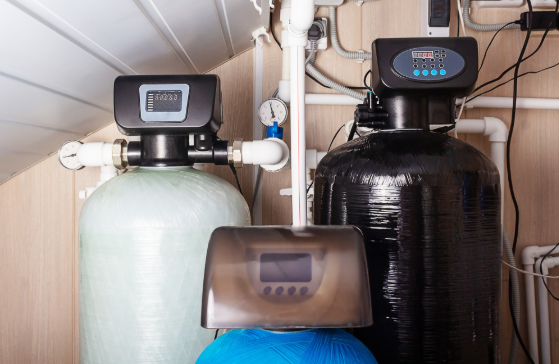
Water softener vs. water filtration system decisions should begin with the condition you want to change. A softener primarily addresses hardness minerals, while a filter must be selected for specific particles, tastes, odors, or substances found in the water.
That distinction matters because scale on a faucet, chlorine taste, reddish staining, sediment, and a laboratory result for a health-related contaminant do not call for the same equipment. Choosing by appearance or product name alone can leave the original concern untreated.
Water sources and household plumbing vary across Montgomery County. Testing the water, identifying whether the whole house or one tap needs treatment, and checking the required flow rate will produce a more useful recommendation than assuming every local home has the same water.
In this article, you will learn about:
- What a water softener does differently from a filter
- Why your water source and test results should guide the choice
- How to select a whole-house or point-of-use setup
- What each system requires after installation
Keep reading to match the equipment to your water instead of paying for treatment that solves the wrong problem.
What a water softener does differently from a filter
The words softening and filtration are often used as though they describe the same process. They do not. A softener exchanges hardness minerals, while filtration covers several technologies designed to capture or reduce selected substances.
Some homes need only one type of treatment. Others need both because the water has separate hardness and filtration concerns that one piece of equipment cannot address by itself.
A softener targets calcium and magnesium hardness
Hardness comes mainly from dissolved calcium and magnesium. These minerals can leave scale on fixtures, interfere with soap, collect on heated surfaces, and create deposits in plumbing equipment.
Most residential softeners use ion-exchange resin. NSF/ANSI 44 covers systems that replace calcium and magnesium ions with sodium or potassium ions and regenerate the resin with the corresponding salt.
Conditions that may support a softener evaluation include:
- White, chalky scale that repeatedly forms on faucets and showerheads
- Spots or mineral film left on dishes and glass
- Soap that lathers poorly or leaves a residue
- Stiff-feeling laundry after washing
- Scale collecting inside water-heating equipment
- A water test that confirms elevated hardness
These observations can justify a hardness test, but they do not identify every substance in the water. A softener should be sized from measured hardness and household demand rather than selected from visible scale alone.
Softening also does not make unsafe water safe by default. If testing identifies bacteria, lead, nitrate, arsenic, or another health-related concern, the treatment plan must include technology certified for that specific reduction claim.
A filter is selected for a particular treatment goal
The term water filter can describe sediment cartridges, activated carbon, specialty media, reverse osmosis membranes, and other equipment. Their capabilities differ, so a filter should never be assumed to remove every unwanted substance.
A whole-house sediment filter may protect fixtures from particles, while activated carbon may address certain taste, odor, or chlorine concerns. A point-of-use reverse osmosis system can reduce selected dissolved substances at one drinking-water tap when its certifications match the test result.
The NSF standards for water treatment systems distinguish several functions. NSF/ANSI 42 addresses certain aesthetic claims, NSF/ANSI 53 covers specified health-effect reduction claims, and NSF/ANSI 58 applies to reverse osmosis systems.
Even certification to a standard is not a promise to remove everything covered by that standard. The product data sheet should name the exact contaminant reduction claim, capacity, replacement schedule, and operating conditions.
One system cannot be judged by the other's job
A softener can reduce hardness without removing sediment or a target contaminant. A carbon filter can improve certain tastes and odors while leaving calcium and magnesium hardness essentially unchanged.
This is why a home's water filtration system should be chosen from the actual water condition. A concern described only as "bad water" is too broad to support a useful equipment recommendation.
Start with the result you want. Protecting a water heater from scale, reducing a chlorine taste, removing visible sediment, and treating a verified drinking-water contaminant are four different objectives.
Once the objective is clear, a plumber or water-treatment professional can match the technology, location, flow rate, and maintenance plan to the household rather than oversizing a generic system.
Why your water source and test results should guide the choice
Montgomery County homes may receive water from municipal systems, other public suppliers, or private wells. The treatment already performed, mineral content, plumbing route, and owner responsibilities differ among those sources.
Groundwater plays a significant local role. The Lone Star Groundwater Conservation District reports that water-bearing units in the Gulf Coast aquifer system support the majority of groundwater production in Montgomery County, but water conditions can still vary by source and location.
The water coming from the source is only part of the picture. Service lines, household pipes, a water heater, and rarely used fixtures can also affect what appears at the tap, so sampling location and symptom pattern matter.
Public-water reports and private-well tests answer different questions
Public water suppliers issue water-quality reports that describe the system's sources, detected substances, and compliance information. Those reports provide important context, but they do not diagnose a condition created inside one property after water leaves the distribution system.
Private-well owners carry more responsibility for routine testing. The Centers for Disease Control and Prevention recommends testing well water at least once every year for total coliform bacteria, nitrates, total dissolved solids, and pH.
Additional testing is appropriate when:
- The water changes in taste, odor, or color
- Flooding or land disturbance occurs near the well
- Part of the well system is repaired or replaced
- A nearby activity raises a new contamination concern
- A pregnant person or young child begins living in the home
- A local health or environmental agency recommends another analyte
Use a state-certified laboratory and sample according to its instructions. A home test strip may help screen for hardness, but it is not a substitute for laboratory analysis when health-related contaminants are involved.
Testing should come before equipment selection. The result tells you what needs treatment, the concentration involved, and whether treatment belongs at the point of entry, a single drinking tap, or another location.
A hardness number is more useful than a vague label
Water that feels hard to one homeowner may seem normal to another. A measured hardness result provides a consistent basis for sizing and programming a softener.
The U.S. Geological Survey classifies water with 0 to 60 milligrams per liter as calcium carbonate as soft, 61 to 120 mg/L as moderately hard, 121 to 180 mg/L as hard, and more than 180 mg/L as very hard.
Those ranges describe mineral hardness, not whether water is microbiologically or chemically safe. A high hardness result may support softening for scale and performance, but it does not prove the presence of a contaminant that requires filtration.
The measured number also helps prevent oversizing. A softener should have enough capacity for hardness and household use without regenerating more often than necessary or allowing exhausted resin to send hard water through the home.
Hot-only symptoms may begin at the water heater
Compare cold and hot water at the same fixture. If particles, color, or odor appear only with hot water, the water heater, anode rod, accumulated sediment, or hot-water piping may be contributing to the symptom.
Mineral scale can collect on heated surfaces and reduce performance over time. Regular water heater maintenance may help manage loose sediment, but treatment should still be based on the incoming water and equipment condition.
If the same symptom appears on both hot and cold sides throughout the house, the supply or whole-home plumbing becomes a stronger possibility. If it appears at only one faucet, the fixture, aerator, or local pipe may be involved.
This comparison keeps a whole-house treatment system from being used to solve a problem confined to one appliance or fixture. It can also reveal when plumbing repair should come before water-treatment equipment.
How to select a whole-house or point-of-use setup
Treatment location affects both performance and cost. Point-of-entry equipment treats water as it enters the house, while point-of-use equipment serves one faucet or appliance.
Whole-house treatment makes sense when the concern affects plumbing, bathing, laundry, or fixtures throughout the property. Point-of-use treatment can be more focused when the goal is drinking and cooking water at one tap.
Whole-house softening must match demand and plumbing
A softener needs enough resin capacity and service flow to handle the household without creating noticeable pressure loss. Hardness, number of occupants, peak simultaneous use, and regeneration settings all affect sizing.
Installation also requires a suitable drain, bypass, electrical supply when applicable, and a location where salt can be added safely. Outdoor faucets or irrigation may be bypassed when softened water is not needed for those uses.
Questions to settle before choosing a unit include:
- What hardness level did the water test measure?
- How much water does the household use during peak periods?
- Which fixtures and appliances should receive softened water?
- Where will regeneration discharge go?
- Is there enough access for salt delivery and routine service?
- How much pressure drop does the proposed unit create at peak flow?
The answers should appear in the equipment recommendation, not be left for the installer to discover after purchase. A properly sized unit balances hardness capacity with acceptable flow and an efficient regeneration schedule.
Existing high water pressure or low-flow complaints should also be evaluated before treatment is added. New equipment should not be expected to correct a pressure problem elsewhere in the plumbing system.
Filtration can serve the whole house or one tap
A point-of-entry filter may be appropriate for sediment, taste, odor, or another verified condition affecting water throughout the home. Cartridge size, media type, housing, flow rating, and replacement frequency must match the tested water and household use.
A point-of-use system can concentrate treatment at a kitchen sink or dedicated drinking-water faucet. That may be more practical when the objective is limited to water used for drinking and cooking.
Reverse osmosis is one point-of-use option, but it should not be installed automatically for every concern. The U.S. Environmental Protection Agency reports that a typical point-of-use RO unit sends at least 5 gallons of reject water down the drain for each gallon treated, while a WaterSense-labeled model must use 2.3 gallons or less.
EPA estimates that choosing a WaterSense-labeled model can reduce water use by more than 3,100 gallons per year compared with a typical point-of-use RO system. The model must still carry a certified reduction claim for the specific substance identified in the water.
Combined systems must be designed as one treatment train
A home with hardness and a separate filtration concern may need more than one process. The order of sediment filtration, carbon, softening, ultraviolet treatment, or reverse osmosis depends on the water analysis and each manufacturer's requirements.
Placing equipment in the wrong order can shorten media life, reduce performance, or expose a downstream component to conditions it was not designed to handle. Flow and pressure loss must be calculated across the combined setup rather than checked one unit at a time.
A whole-home plumbing diagnosis can also identify corroded piping, failed valves, pressure issues, or water-heater sediment that treatment equipment alone will not repair.
Ask for a simple treatment sequence showing what each stage addresses. Every component should have a specific purpose tied to a test result, a verified aesthetic concern, or protection required by the next piece of equipment.
What each system requires after installation
Water treatment continues after the equipment is installed. Resin, salt, cartridges, membranes, lamps, seals, drains, and bypass valves require different checks and replacement schedules.
The ongoing work affects operating cost and performance. A lower purchase price may not remain lower if the system consumes more water, requires frequent cartridges, or is difficult to service in its installed location.
Maintenance should be part of the original comparison
A softener normally needs salt or potassium chloride, an unobstructed brine system, correct programming, and periodic inspection. A filter needs replacements based on capacity, time, pressure drop, or water quality, depending on the product.
Waiting until water quality visibly declines can allow exhausted media or a neglected component to stay in service too long. Follow manufacturer instructions and keep a record of dates, settings, test results, and replacement parts.
Include these recurring needs in the decision:
- Salt or potassium chloride use and refill access
- Regeneration frequency and discharge water
- Filter cartridge or media replacement cost
- Membrane, lamp, or prefilter service when applicable
- Periodic hardness or water-quality retesting
- Bypass-valve and leak inspection
The service schedule should reflect the actual water. A heavily loaded sediment filter may need attention sooner than the calendar suggests, while an oversized cartridge changed too frequently wastes usable capacity.
Keep the product data sheet and certified claims with the service record. Future testing can then confirm whether the system still addresses the original condition or needs adjustment as water use and household needs change.
Flow rate and pressure matter after the first week
Treatment equipment can perform well in a laboratory yet disappoint in a home if it is undersized for simultaneous use. A shower, washing machine, dishwasher, and outdoor fixture can create a much higher peak demand than one faucet.
Ask for the service flow rate and expected pressure drop, not only the tank or cartridge dimensions. Whole-house equipment must maintain acceptable performance when several fixtures operate together.
A pressure drop that appears only after installation may point to undersizing, a clogged prefilter, incorrect valve settings, or an existing supply problem. It should be diagnosed rather than accepted as an unavoidable feature of treated water.
Bypass testing can help isolate the equipment from the rest of the plumbing. If pressure returns when the system is bypassed, the treatment train, media condition, or sizing deserves review.
Compare verified performance instead of broad promises
Two systems described as whole-house filters may have different media, flow limits, certified claims, and replacement costs. Two softeners may differ in resin capacity, salt efficiency, control settings, and peak service flow.
The most useful proposal names the test result, explains the treatment method, identifies the certification or performance claim, and lists ongoing maintenance. It should also clarify which concerns the system will not address.
Avoid claims that a single unit removes everything or fixes every water problem. Residential plumbing services may still be necessary when discoloration, low pressure, or sediment originates in household pipes, fixtures, or a water heater.
Retest when the treatment goal involves a measurable substance. Confirmation after installation shows whether the system is performing as intended and creates a baseline for future maintenance.
Conclusion
A water softener and a water filtration system solve different problems. Softening targets calcium and magnesium hardness, while filtration must be matched to the particles, tastes, odors, or verified substances you want to reduce.
Testing prevents guesswork. It distinguishes hardness from contamination, shows whether the issue affects hot and cold water, and helps determine whether treatment belongs at the whole-house entry point or one drinking-water tap.
The right system should also fit household flow, available space, drainage, and realistic maintenance. When a home needs both softening and filtration, the equipment should be designed as one coordinated treatment train.
Contact Benjamin Franklin Plumbing of Conroe to ask about the Club Membership Program and discuss water-treatment concerns for your Montgomery County home.

 Your Privacy Choices